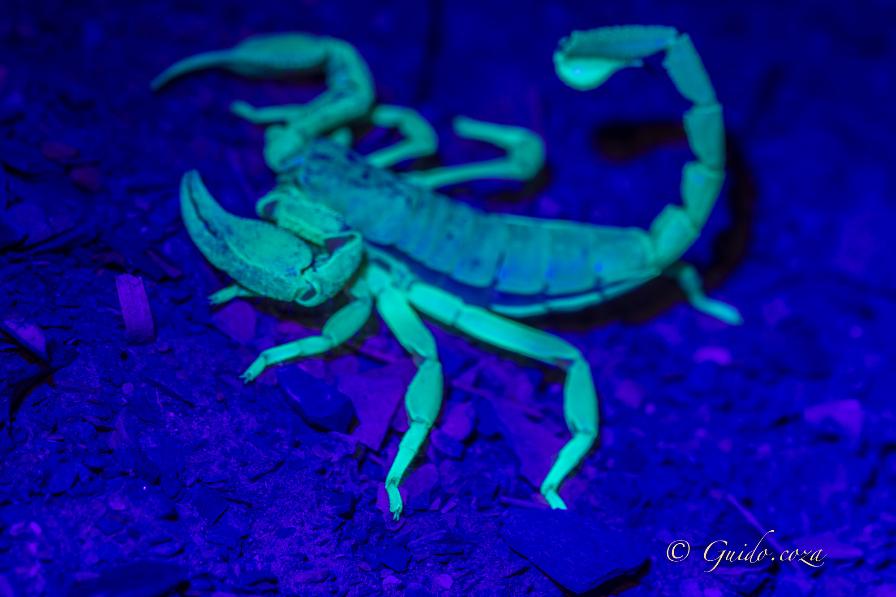
Why do Scorpions "glow" under UV light
To tell you the truth, nobody knows for sure!!
The truth is, at night, and nearly all scorpions are active at night, there is no UV light. The Moon, the only natural light source worth mentioning , does not reflect UV light. That means, if there is no UV light it can't be seen, can't be reflected - and can't make things glow!
Lets start at the beginning: What actually DOES make scorpions "glow" under UV light? This, in itself, was for long a mystery. Recently it was found that it is a fungus which the scorpion carries. Every scorpion, irrespective of colour or species, whether yellow, brown or black, venomous or relative harmless, has this fungus. Why exactly is this? Originally it was suspected that the fungus would help against bacteria, such as the penicillin type fungi which has bacteria suppressing qualities. However, it could be argued that most scorpions inhabit relative "sterile" or dry environments. Creatures like the Myriapods would then be the most likely candidates as they prefer to live in moist and warm substrates, very conducive to the development of fungi. Yet scorpions are the only Arthropods with this feature!
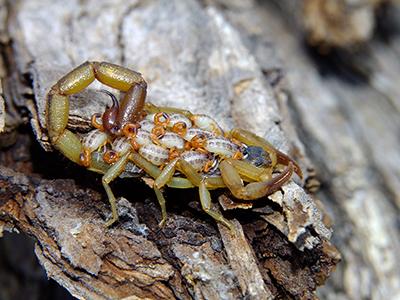
Now how does the scorpion get to its unusual payload? After the eggs are lays the female watches over her brood and waits and guards her eggs till they hatch. Now the young are lifted on Mom's back and carried around till they brood completes the second shedding of skin. The fungi gets transmitted during this time period.
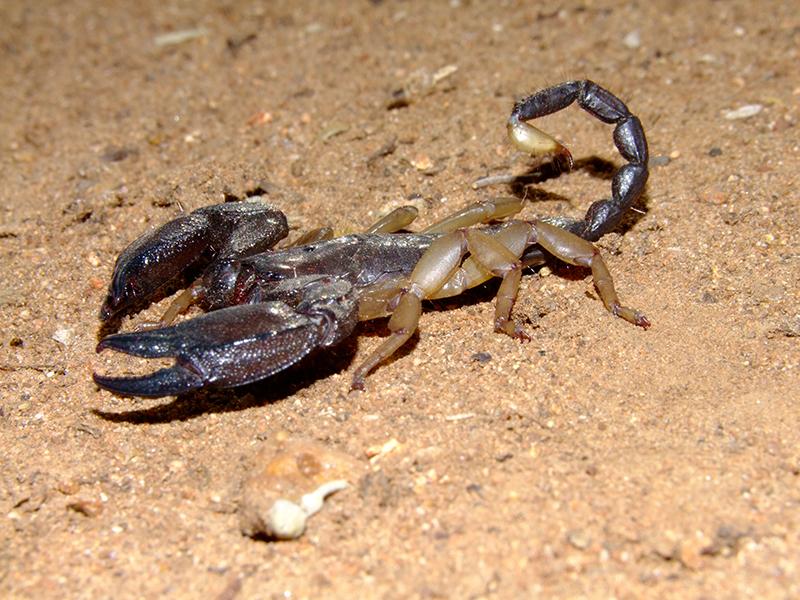
Now, after the second shedding the young scorpions leave there mother back and have to fend for them-self, equipped with all they need to survive. A pair of Pincers, which in most cases can tell a lot about the danger they pose to mankind. As general rule, the bigger the pincers in relation to the size and thickness of the tail, the less venomous is the little beast.
This makes logical sense. With 2 big powerful "hands" I can hold and crush and rip apart my prey.
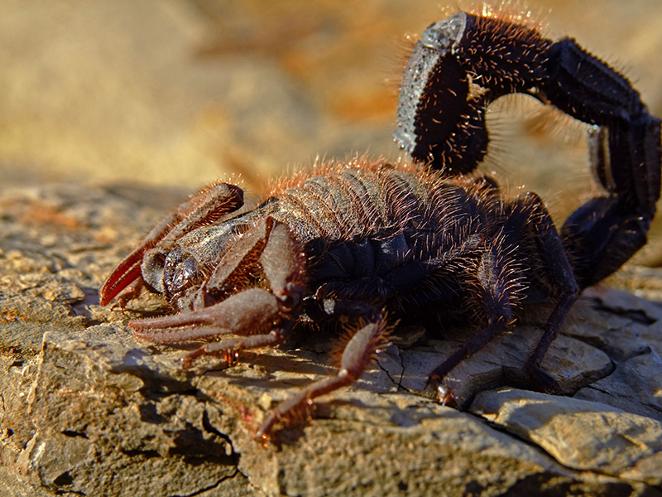
Contrary the, sometimes even possibly fatal to human, thick-tail Scorpions for example Parabuthus ssp have ridiculously small pincers.
Stays the question with the light. The fungus gets moved, via spore during each shedding. This explains why freshly sledded scorpions do not glow. Here could the fungus not colonize the new exoskeleton. The Fungus remains also for a long period of time on the shedded skin, as glowing skin fragments are a tell-tail sign for the presents of a scorpion, even if the scorpion itself nowhere can be found.
Stays the question, why in the first place the fungus and why a fungus that glows under UV light? Coincidence? There is no such thing like coincidence in Nature. Everything has a reason, everything has a function. We have been to the Moon, send a spacecraft to Mars, developing nano devises which should run on a laser-beam to the next galaxy but we do not know, why a scorpion glows under UV light!
The Pofadder (Bitis arietans)
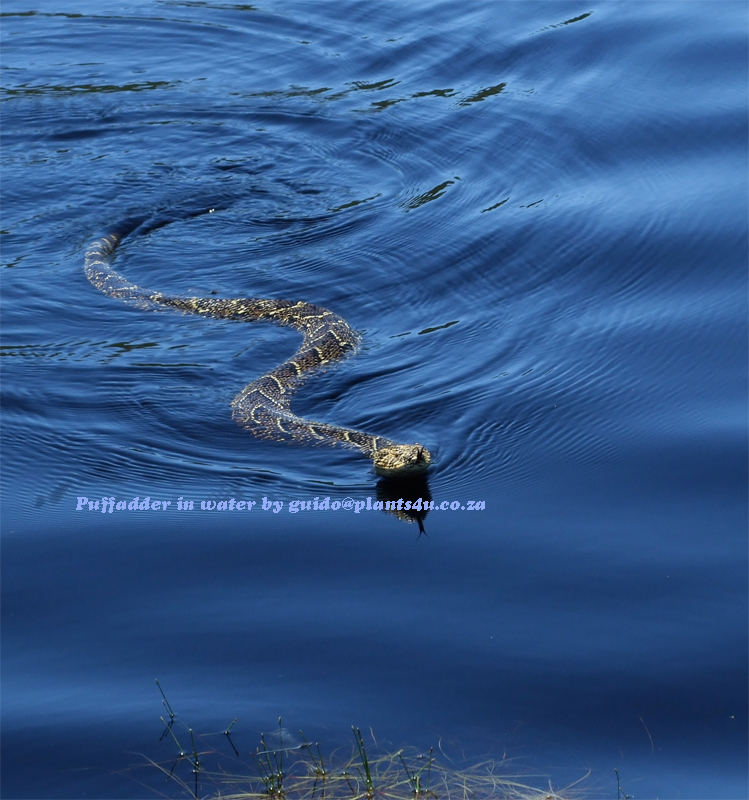
The Pofadder is, not surprisingly, one of the best known snakes of Africa. The distribution is virtually over the whole continent, with the exception of densely forested areas. The snake is found from sea-level till 2000m. The pofadder is also still responsible for most off the snakebites and most fetalities by snakebites on the continent. Pofadders are sluggish stout snakes which can reach a lenght of 1.2m-1.3m in the south and in the far north up to 1.8m. There pray is everything that fitts into there mouth, most commonly rodents, ground birds, and amphibians. The Pofadder is known to be an excellent and willing swimmer and is often seen in water. It would not surprise me if the odd Fish is ending up as a meal for this interesting snake.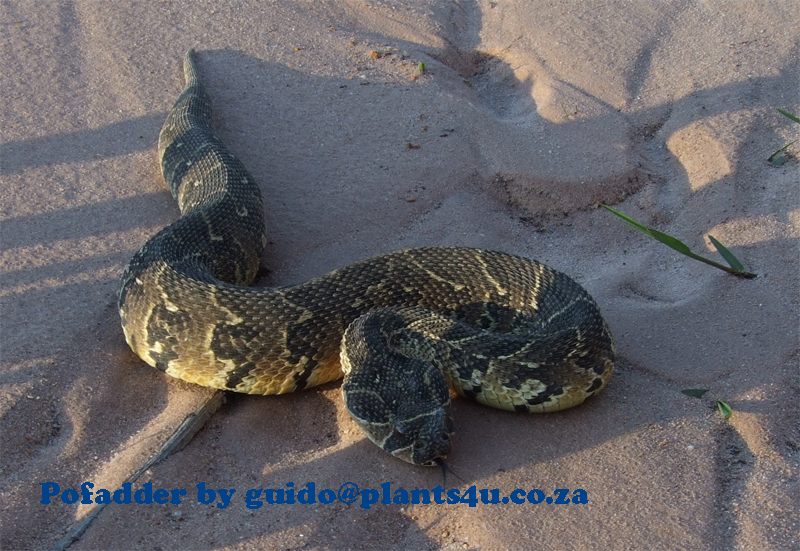
Being a rather plump heavy weight, climbing trees is not the strong point of this snake but the pofadder has another unic form of locomotion. I would best discribe it with the "Caterpillar crawl", in a absolute strait line just the bottom scales moving.